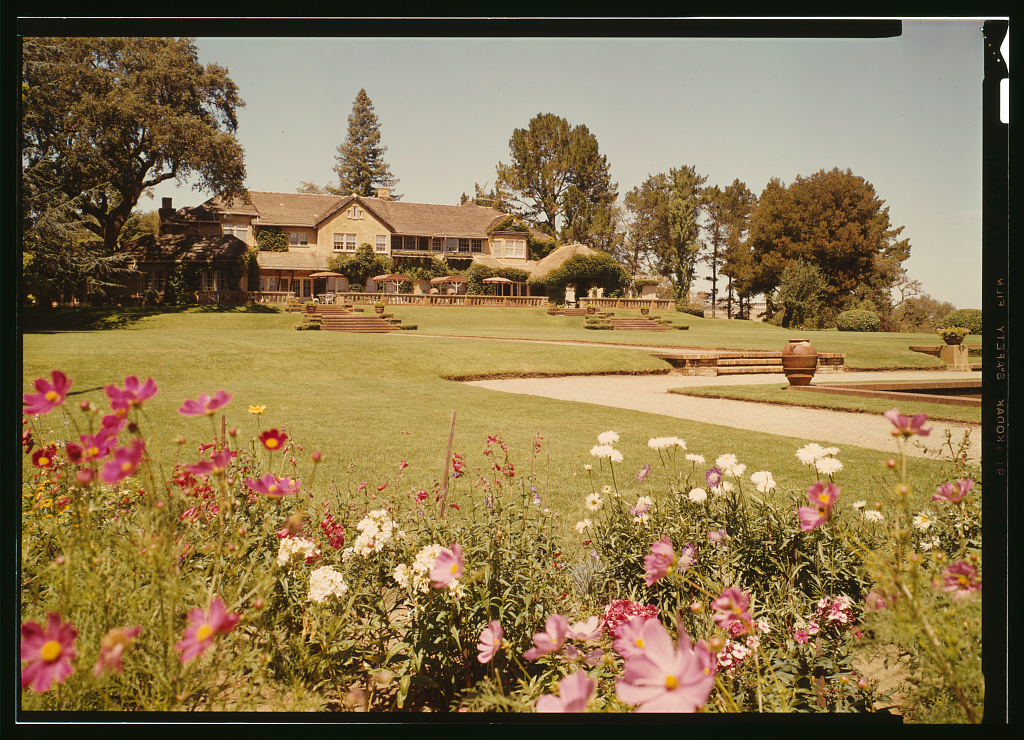
Woodside, California | 1911
- Architects: Charles Sumner Greene & Henry Mather Greene
- Style: Arts & Crafts / English Country Estate
- Completed: 1911
- Original owner: Mortimer Fleishhacker Sr.
- Most recent asking price: $110 million (2024)
- Most recent sale: Approximately $85 million (September 2025)
If Frank Lloyd Wright sought to reinvent the American middle-class home, Charles and Henry Greene occasionally worked at the opposite end of the spectrum, designing sprawling estates for California’s industrial elite. Few commissions demonstrate that better than Green Gables, the remarkable Woodside estate created for San Francisco businessman Mortimer Fleishhacker Sr.
Calling Green Gables a “house” barely does it justice. The property encompasses roughly seventy-four acres with multiple residences, formal gardens, barns, recreational buildings, and one of the most extraordinary landscapes ever developed on a private American estate. Although later architects—including William Wurster—contributed additional buildings over the decades, the original Greene & Greene residence remains the artistic heart of the compound.
Unlike the intimate warmth of Pasadena masterpieces such as the Gamble House, Green Gables reflects the brothers adapting their Arts & Crafts philosophy to a grand country estate. Heavy timber framing, deeply overhanging roofs, handcrafted woodwork, and an extraordinary sensitivity to the surrounding landscape create an estate that feels monumental without becoming ostentatious. The architecture is expansive yet remarkably restrained, relying on natural materials and exquisite craftsmanship rather than decorative excess.
The estate remained in the Fleishhacker family for more than a century—an almost unheard-of period of continuous ownership for a property of this scale. During those 114 years, successive generations preserved not only the principal residence but also the surrounding landscape that gives the architecture its remarkable sense of place.
When the property first appeared on the market in 2021 with a reported asking price of approximately $135 million, it immediately became one of the most significant residential listings in California. After being reintroduced at $110 million, Green Gables ultimately changed hands in September 2025 for approximately $85 million, still one of the largest residential sales in Northern California history.
For students of American architecture, the transaction represented something larger than a luxury real-estate headline. It marked the first transfer of stewardship for one of Greene & Greene’s most ambitious residential commissions after more than a century of single-family ownership—a reminder that even architectural landmarks occasionally begin a new chapter.
Why it matters: Green Gables demonstrates that Greene & Greene were capable of far more than the celebrated California bungalow. At estate scale, their commitment to craftsmanship, natural materials, and harmonious landscape design produced one of the great country houses of the twentieth century.
Suggested reading: The estate’s sale attracted international attention because of both its architectural pedigree and its record-setting price, offering a rare glimpse inside one of America’s finest privately owned Arts & Crafts estates.