• Green Gables Estate

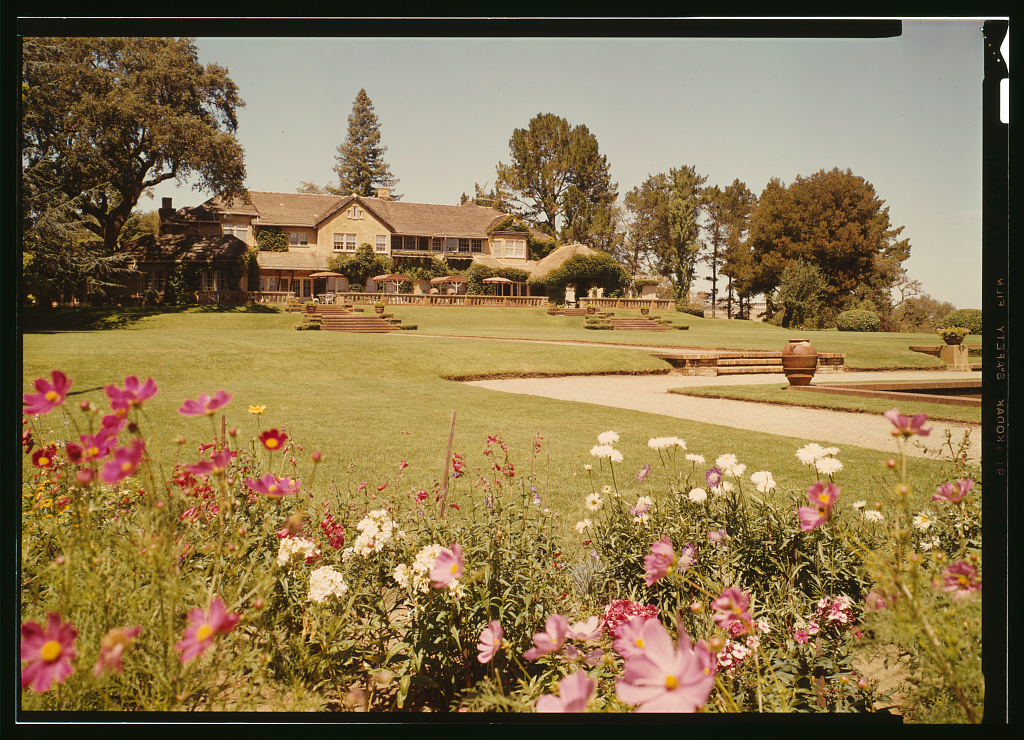
    Green Gables Estate in Woodside, California, designed by Greene & Greene
    Green Gables Estate in Woodside, California. The 74-acre compound is one of the largest surviving residential commissions associated with Greene & Greene.

    Woodside, California | 1911

    • Architects: Charles Sumner Greene & Henry Mather Greene
    • Style: Arts & Crafts / English Country Estate
    • Completed: 1911
    • Original owner: Mortimer Fleishhacker Sr.
    • Most recent asking price: $110 million (2024)
    • Most recent sale: Approximately $85 million (September 2025)

    If Frank Lloyd Wright sought to reinvent the American middle-class home, Charles and Henry Greene occasionally worked at the opposite end of the spectrum, designing sprawling estates for California’s industrial elite. Few commissions demonstrate that better than Green Gables, the remarkable Woodside estate created for San Francisco businessman Mortimer Fleishhacker Sr.

    Calling Green Gables a “house” barely does it justice. The property encompasses roughly seventy-four acres with multiple residences, formal gardens, barns, recreational buildings, and one of the most extraordinary landscapes ever developed on a private American estate. Although later architects—including William Wurster—contributed additional buildings over the decades, the original Greene & Greene residence remains the artistic heart of the compound.

    Unlike the intimate warmth of Pasadena masterpieces such as the Gamble House, Green Gables reflects the brothers adapting their Arts & Crafts philosophy to a grand country estate. Heavy timber framing, deeply overhanging roofs, handcrafted woodwork, and an extraordinary sensitivity to the surrounding landscape create an estate that feels monumental without becoming ostentatious. The architecture is expansive yet remarkably restrained, relying on natural materials and exquisite craftsmanship rather than decorative excess.

    The estate remained in the Fleishhacker family for more than a century—an almost unheard-of period of continuous ownership for a property of this scale. During those 114 years, successive generations preserved not only the principal residence but also the surrounding landscape that gives the architecture its remarkable sense of place.

    When the property first appeared on the market in 2021 with a reported asking price of approximately $135 million, it immediately became one of the most significant residential listings in California. After being reintroduced at $110 million, Green Gables ultimately changed hands in September 2025 for approximately $85 million, still one of the largest residential sales in Northern California history.

    For students of American architecture, the transaction represented something larger than a luxury real-estate headline. It marked the first transfer of stewardship for one of Greene & Greene’s most ambitious residential commissions after more than a century of single-family ownership—a reminder that even architectural landmarks occasionally begin a new chapter.

    Why it matters: Green Gables demonstrates that Greene & Greene were capable of far more than the celebrated California bungalow. At estate scale, their commitment to craftsmanship, natural materials, and harmonious landscape design produced one of the great country houses of the twentieth century.

    Suggested reading: The estate’s sale attracted international attention because of both its architectural pedigree and its record-setting price, offering a rare glimpse inside one of America’s finest privately owned Arts & Crafts estates.

  • Greene & Greene properties: a spreadsheet

    I’ve been moving most of my text documents and spreadsheets over to the very helpful Google Docs (which also lets you create powerpoint-compatible presentations) – a great app that basically lets you have access to and share all your documents from wherever you are in the world – and just moved this database over. It’s a list of all still-extant Greene & Greene properties, including some civic non-residential structures (walls, etc.); this is the same list I made this Platial map from. I hope it’s useful to you … If anyone is interested in helping me make a similar database/map for Maybeck, Frank Lloyd Wright and other architects of the movement, let me know.

  • Greene & Greene properties: a map

    So, I’ve created a map – using social-mapping tool Platial – of all the existing Greene & Greene properties I’ve been able to find record of. I’ll also be adding a new layer of no-longer-standing Greene & Greene projects, but that’s a few weeks off.Take a look, and let me know if you like this style of map and if the tool is easy to use; if so, I’ll revive our Craftsman Home Registry (above) using this, so you can all add your own homes.

  • off-topic: the new Google Maps and how to REALLY improve them

    I posted this over at Urban Cartography, but thought some people here might be interested too, especially since my test use of this new technology will be to make a map showing the locations and some background data on all still-existing Greene & Greene properties here in California.

    I was all excited to learn that Google is now allowing user-created
    data in custom maps. This is great! However, when I went to go play
    with it, I learned the current implementation – which in most ways is
    an alpha release – is missing 90% of what could make it useful. Such as:

    • the ability to import, not just export, addresses. I want to
      make a canonical map of all currently existing properties by the late
      great architects Greene & Greene; this is not very easy by
      hand-entering every single one. However, if I could import
      tab-delimited text, I could have the full list of 200 up in a few
      minutes!
    • the ability to display multiple maps at once – on top of each other
      (i.e., LAYERS). this would make google maps a useful tool for data
      analysis: you could display maps of different data layers at once, but
      what would make this feature REALLY shine would be…
    • the ability to pipe in data from online databases. if you combined
      #1 with the ability to bring data in from online databases, not just
      uploaded text files, you could use this with the ability to see
      different layers at once to see real causality – that is, you could see
      how income, for example, and property values, tax base, parks, etc. all
      interact. It would be a really democratic tool – the ability, for
      example, to see if public works projects actually happen in poor
      neighborhoods as they do in rich, or to see what zipcodes public
      university admissions come from (if that data were available), or to
      see what area codes had the most telemarketer calls originating, etc.
      In fact, this would turn Google Maps into the ultimate social
      researcher’s dream tool – the killer app that sociologists, activists,
      criminologists and others have been waiting for.

    Just a few (big) suggestions for the Google Maps folks to think about…