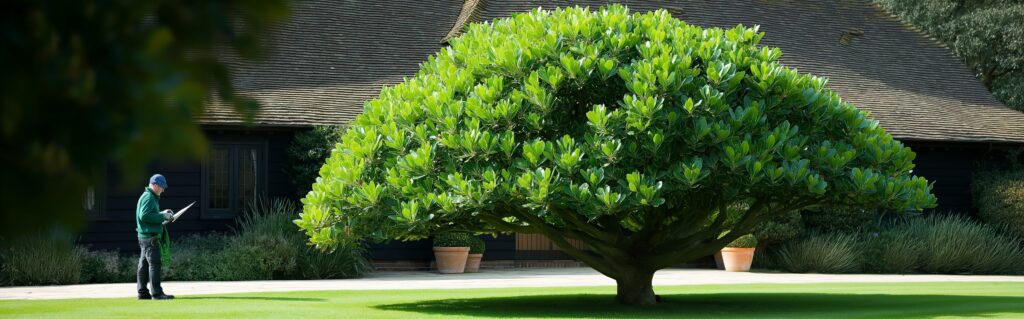
Professional arborists offer a variety of services, from insect and disease control to growth regulators and tree treatments, as well as tree root fertilization. These and other tree maintenance solutions can help improve tree health and support local ecosystems in residential properties. The roles of an arborist extend beyond those of tree trimmers, who mainly focus on basic cutting or pruning and shaping of trees. Here are a few key differences between an arborist and a tree trimmer:
Service Scope
Arborists focus on promoting the long-term health of trees through services like tree diagnoses and injections or treatments. This makes an arborist an ideal professional if you want expert help controlling insects and diseases. These experts understand how to assess the unique biological and environmental needs of various species across different areas to provide tailored preventive care, such as tree injections.
Tree trimmers focus on offering physical tree maintenance services, such as cutting and removing dead trees or branches and pruning. Services from a tree trimmer may be ideal for aesthetic purposes and enhancing safety by removing hazardous branches. An arborist can also help assess your trees’ structural stability and growth patterns to determine ideal preservation methods.
Specialized Equipment
An arborist combines both standard pruning tools and specialized diagnostic equipment for a comprehensive assessment of tree health. Tools such as increment borers and resistographs enable an arborist to assess trees for issues such as structural weakness or internal decay. An arborist may also use precision tools such as loppers and pruning saws. These pruning tools enable clean, targeted cutting that aligns with a tree’s biological standards, for faster healing and enhanced health. Tools tree trimmers can use for efficient removal of tree branches and routine shaping include power saws and pole pruners.
Some specialized techniques a tree doctor may employ include disease treatments, soil aeration, bracing, and cabling. These techniques contribute to improving trees’ structural integrity and prolonging their life. While tree trimmers focus on general pruning techniques for quick branch removal and shaping, arborists take a more tailored approach using specialized tools. Tree trimmers’ equipment is designed for standard, repeatable trimming, whereas arborists can customize their methods to the tree’s specific needs.
Structural Expertise
An arborist possesses extensive knowledge of things like tree anatomy, soil interactions, and tree physiology. Professional arborists understand the specific pests and disease risks that affect different types of trees, including magnolias and oaks. This knowledge allows them to accurately assess and address issues such as vascular diseases, root rot, and other threats to tree health. By diagnosing these and other tree issues, an arborist can recommend targeted interventions like fertilization and also conduct tree injections. Since tree trimmers lack expertise in tree biology, they specialize in structural cuts.
Hire Professional Arborists Today
An arborist possesses expertise that enables them to conduct health assessments and manage insects and diseases in trees more effectively. Tree trimmers can be ideal for efficiently handling mechanical or physical tree upkeep. Call a trustworthy arborist today to safeguard your trees’ long-term health and aesthetics.
partnered post
