architecture

  • Sunset Idea Neighborhood

    You’ve probably read about the Sunset Idea House – a model house showing off the newest building techniques, materials and design possibilities of recent years that the Sunset Magazine folks build at their Menlo Park campus every year since 1998. However, not every single "idea house" is in Menlo Park; in 2003, Sunset  brought us a new project: the Sunset Idea Neighborhood, a model development of two Craftsman bungalows built by Mark De Mattei and his firm De Mattei Construction. These homes sit next to each other on a hillside in Los Gatos, not far south of San Francisco and just over the mountain from Santa Cruz.

    This wasn’t De Mattei’s first project with Sunset, either; the previous year a 66-year-old Willow Glen property that he remodeled and restored was featured in a series of articles – "Diary of a Remodel" – the first such remodel diary that Sunset published, a type of content which is now quite popular in that and many other publications. And in another touch that the always practical-minded folks at Sunset thought up, you can even buy the plans for this home online.

    These won’t be De Mattei’s last projects with the magazine; this year, Sunset partnered with Popular Science magazine to feature not just contruction materials and techniques but building and entertainment technologies as well with the 2006 House of Innovation, also built by De Mattei. This Silicon Valley property is open to the public from early September through late November 2006.

    Of course, the Idea House project is a great deal for Sunset; not only do visitors pay admission to see the current iteration of the idea house (the current/upcoming Celebration Idea House debuts at their Menlo Park campus on the May 20/21 weekend; admission is free with the $10 admission charge to the "celebration weekend" event), the house itself is for the most part a showcase of products made by the magazine’s many advertisers. Maybe some Sacramento architect or designer should contact me about a possible Hewn & Hammered idea house!

  • How to View a Wright House

    Heinz041606_285by Kevin Nance – reprinted with permission from the Chicago Sun Times
    photograph: Thomas Heinz, author of the Frank Lloyd Wright Field Guide (photo by Jim Frost / Sun-Times)

    In the late 1960s,Thomas A. Heinz, then a student at the University of Illinois, received
    a book with pictures of Frank Lloyd Wright’s 100 or so buildings in the
    Chicago area. Intrigued by the photographs, Heinz drove up to Oak Park,
    where he was struck by how different — often radically different —
    the Wright houses looked in real life.

    "The two-dimensional photograph can’t begin to suggest what he put into the house for the
    observer," says Heinz, now an architect, author and photographer based
    in Mettawa. "The typical Wright house is meant to be walked by, driven
    by, lived in, not just seen from a single perspective-and that’s where
    I think Wright’s buildings are so different from everyone else’s, and
    why photographs are often so deceptive. The photographer will take full
    advantage to bring you the best of the building, using wide-angle
    lenses, narrow cropping and so on, which alters your perception of it.
    Seeing it in person, you get so much more of th
    e colors, textures and context of the building."

    For example, photographs of Heinz’s favorite Wright building — the Robie House on
    the University of Chicago campus — tend to make it look as if it were
    situated on a two- or three-acre lot, when in fact it’s what Heinz
    calls "plunked down" on a corner and almost crowded by other
    structures. On the other hand, the same photographs don’t convey the
    sheer majesty of the house’s textured copper gutters, its massive brick
    piers and heavy limestone planters. (article continued below)

  • Green Gables – Greene & Greene’s Fleishhacker Estate

    Greengablesgrayscale

    Woodside, California – a posh hillside community above Redwood City and Palo Alto, not far south of San Francisco – is often thought to be one of the brothers’ most impressive properties, although its design and building was overseen only by Charles Greene. Designed in 1911 as a vacation home for the prominent San Francisco Fleishhacker family, the house – known as Green Gables – was open for special events in the 1970s and 1980s, but is now used by the fourth generation of the Fleishhackers and is no longer accessible to the general public.

    The Fleishhackers apparently believed the Greene’s style to be "too
    Japanese" for their tastes, which ran toward a thatched-roof English
    country cottage, but Bruce Smith notes that after they were so charmed by him in several one-on-one meetings, they decided to work with Charles on
    his own.

    The house itself is perhaps the most open and airiest Greene-designed property, with high plaster ceilings with coped corners, large windows and doors all around and many small details that will look familiar to anyone who knows the Greenes – bas-relief patterns on the ceilings and in woodwork, interesting custom-made tile throughout and joinery elevated to art. The house is centered on a 75-acre wooded parcel, and includes a 300-foot pool that ends in a series of arched columns resembling Roman ruins; this and other aspects of the water garden (which includes a 65-foot stone stairway) were implemented by Charles during his long-time association with the Fleishhackers. Given his many years of work on the gardens and various alterations to the house and outbuildings, I think it is fair to say that Green Gables was the single largest and most involved project either of the Greenes was ever involved with.

    The enormous lot is now protected from subdivision by an easement, a 2004 gift from the Fleishhackers to the Garden Conservancy; much of it, as well as a good portion of the interior of the house, can be seen in the 1999 Robin Williams film Bicentennial Man.

    Photographs of the building and the early gardens are available online from Columbia University’s Avery Architectural Library; blueprints and other documents are up on the USC archive site.

  • Craftsman Style in the News

    Lots of articles on my favorite style of design & architecture in newspapers and magazines lately; the Arts & Crafts renaissance continues to go mainstream.   

  • James Plachek & Berkeley

    PlacheklibrarygreenOne of the houses I grew up in is a 1917 wood-shingle quasi-bungalow at the base of the Berkeley Hills, near the Solano tunnel. The house was designed by James Plachek, who was responsible for the art-moderne Berkeley Library, Berkeley’s Heywood Building, Epworth Hall, the Grace Congregational,  and a number of other structures throughout the state, including the now-closed UC Theater (also 1917), where I worked on weekends and in the evenings after school in the late 1980s. Plachek built and remodeled a number of theaters between 1915 and 1930, including the Chimes in Oakland and the Lorin (now the Phillips Temple Church) at 3332 Adeline in Berkeley. In the mid 1930s, Plachek was focused primarily on large-scale WPA projects like the immense Moderne Alameda County Courthouse on the shore of Lake Merrit, shown here in Michele Manning‘s beautiful plein air pastel drawing.

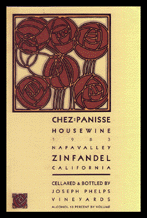
    Before my father bought the house, the previous owners hired woodworker and light fixture designer Kip Mesirow, who made a number of alterations and improvements to Chez Panisse (in the same building where, coincidentally, my father lived as a student at UC Berkeley, before it was a restaurant) in the 1970s, and a collaborator of printmaker and illustrator David Lance Goines
    – to finish the attic and turn it into a beautiful, raw-redwood-wall
    master suite, a sort of mixture of rustic cathedral, nordic cabin and Japanese country house.

    Mesirow’s improvements to both my father’s house and Chez Panisse
    are a bit more Rennie Mackintosh and Wright  than Maybeck, embracing the austere
    and geometrical forms that Mackintosh loved and Wright emulated; these shapes
    repeat in much of the Chez Panisse style both in and out of the restaurant itself, most notably Goines’ many poster and cookbook designs for the restaurant and the lettering over the restaurant’s entrance. Goines even uses the Mackintosh rosette in a few of his own illustrations.

  • Welcome PrairieMod

    Newly-established Prairie style weblog Prairie Mod (dob: February 18) promises lots of good stuff on Prairie design and architecture:

    Welcome to PrairieMod. This site represents a chance for me to expose
    the world to the newest ideas in a movement I and my circle of cohorts
    like to refer to as Prairie/Modern (aka PrairieMod). It’s the 21st
    century re-examination into the ideas and ideals of the Praire School
    and the Arts and Crafts Movement (with a little Art Nouveau, Art Deco,
    and Bauhaus thrown in for zest). I’ll be posting my thoughts and
    explorations in conjunction with book reviews, merchandise finds and
    anything else that catches my fancy. Expect to see a fair amount
    devoted to the works of Frank Lloyd Wright and other Prairie School
    artists and architects. Feel free to post your feedback and let me know
    what you think!

  • Beating Craftsman Style Into Submission

    Here’s a real estate agent selling a 1906 Hillsborough brown shingle that was supposedly "inspired by the atelier of Bernard Maybeck." The house has obviously been remodeled several times, as very little externally (and practically nothing internally, at least as far as the photographs show) looks even remotely Maybeckian. There’s a sort of Queen Anne vs. Craftsman thing going on with some of the Victorian cottage glass and the curved portico. And the inside – I’m crying for what it must have been. It is, today, the most banal and generic (and totally non-Craftsman) guts I’ve ever seen picked to replace what was probably interesting, quirky and maybe actually inspired by Maybeck. Who knows. All I can say is, it looks like the current owners and their decorator both hated Craftsman style and are trying very hard to make this 1906 home safe for suburban tastes. Practically everything about this home is what the Arts & Crafts movement worked so hard against. Well, at least the back porch is pretty. If you’ve got 2.9 million to spend, I guess you can afford to put it back the way it should have been, anyway.

    At least this particular agent seems to do a bit better with her other listings, although the prices in Burlingame are higher than I could have imagined.

    I’m going to update my most recent criticism of sellers and their real estate agents being uneducated about their properties with an even greater pet peeve: opportunistic sellers and agents who use the cachet of "Craftsman" on properties that are anything but. In this case, the house might once have been, but the "Maybeck-inspired" beauty that may have once stood there died a messy death at the hands of someone with more money than taste.

  • Marrying (into) A House

    Liz Jaros has a nice article on what happens when you marry (or marry into – same thing) a house, in this weeks’ Journal of Oak Park and River Forest.

    We chuckle after the front door handle comes off in a guest’s hand. A constant breeze blowing in under the back door (an oversized monster of a door that made one potential contractor walk away laughing) prompts us to introduce the kitchen as a three-season room to friends who’ve come for a tour. We consider letting the kids sled down the front steps when a sagging gutter turns the porch into a mountain of ice. And when the pull of a closet light chain separates the fixture from the ceiling, sending a shower of plaster down onto our sweaters, we take it with good humor.

  • If Walls Could Talk looks to Alabama, Connecticut

    Each episode of HGTV‘s If Walls Could Talk profiles a particular family and the stories that their historic home has been witness to over the years. The motto of the half-hour program – "every home has a history" – is taken to heart in the ‘house ethnographies’ of properties ranging from turn-of-the-century Hollywood bungalows to a 1600s log home in Massachussetts.

    HGTV is based in Tennessee, but has investigated houses in all corners of the country pretty even-handedly – in more than 150 episodes since 1998. Right now, however, they are looking for stories in Alabama and Connecticut. If you have a home with an interesting history, or one that’s been witness to any particularly interesting events or host to any especially interesting characters, do get in touch with the research coordinators as soon as possible.

    Alabama: Jaime Levi (303.712.3106 or email); Connecticut: Keri Grogan (303.712.3110 or email).